
Introduction
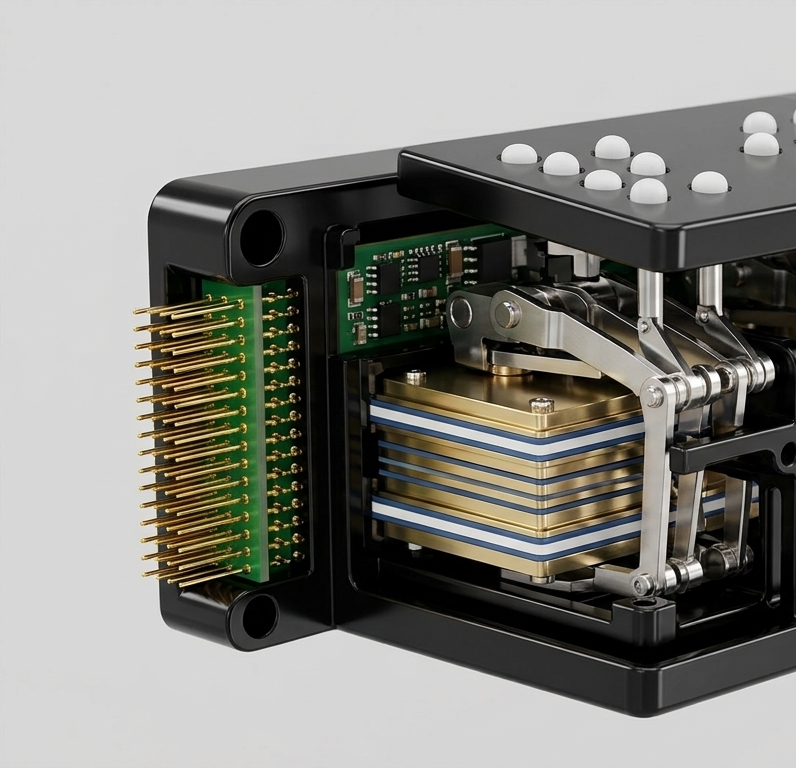
Access to digital literacy remains one of the most critical challenges facing the global blind and visually impaired community. While refreshable Braille displays provide a vital bridge to education and professional opportunities, their widespread adoption is severely constrained by prohibitive manufacturing costs. Traditional solid-state piezoelectric actuation mechanisms, while precise, rely on specialized smart ceramics that drive retail prices into thousands of dollars per unit. Our research addresses this economic disparity directly by redesigning the foundational architecture of the Braille cell.
The Core Challenge: The Cost of Tactile Feedback
The primary cost driver in modern refreshable Braille displays is the individual actuation of tactile pins. Engineering a grid of dynamic dots that maintain a strict 2.45mm pitch while providing enough structural rigidity to withstand human fingertip pressure typically demands expensive, high-voltage component ecosystems. For decades, this barrier has restricted advanced educational technology to well-funded institutions, leaving millions of learners in developing regions isolated from inclusive digital learning environments.
Research Methodology & Innovation Framework
Our ongoing project investigates alternative electromechanical architectures and accessible material combinations designed to eliminate the reliance on high-cost piezoelectric bimorphs. The focus rests on two parallel optimization streams:
- Mechanical Multiplexing: Evaluating shared-driver architectures that leverage miniature, high-torque micro-motors to actuate passive tactile arrays, bypassing the need for dedicated per-dot electronic crystals.
- Staggered Matrix Ergonomics: Designing high-resolution, fanned-out geometric frameworks that utilize low-voltage, scalable components while maintaining standard international Braille dimension specifications.
Anticipated Impact
By transitioning from rare-material solid-state physics to highly optimized, injection-molded or high-precision resin-fabricated electromechanical systems, the preliminary data indicates a potential reduction in base component manufacturing costs by up to 80%. Achieving this benchmark will pave the way for a new tier of highly affordable, robust, and fluid-resistant digital literacy tools, unlocking an equitable learning ecosystem for visually impaired students globally.